
Skyhook Tools

Building a SaaS roadmapping platform that turns project data into decisions — from design validation to live product
Skyhook had the designs and the storyboard. They needed a team that would challenge both before writing a line of code — then build the whole thing in 7 months.
Development Team
Bi-weekly reporting
A prioritisation and roadmapping tool for the people who own the decisions.
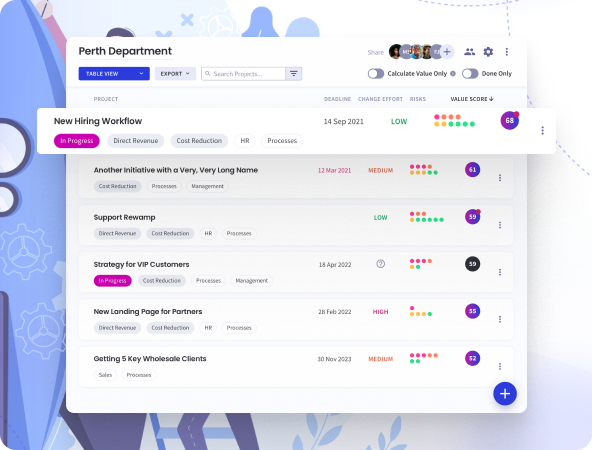
Skyhook Tools is a web-based SaaS that helps businesses decide which projects to pursue — and which to deprioritise. The platform scores projects against business value, customer impact, risk, cost, and complexity, then surfaces that analysis visually so decision-makers can act on it.
The users are the people who live in these trade-offs: project managers, executive teams, team leaders, risk and finance officers, and the consultants who advise them. The product is designed to give them the insight they need without requiring them to build it themselves.
Designs in hand. Now they needed fast-cycle development — with proper validation first.
The Skyhook team had done the upfront thinking. Feature analysis and storyboarding were complete. What they needed was a development partner who could move at pace, but not skip the step of actually reviewing those designs properly before building began.
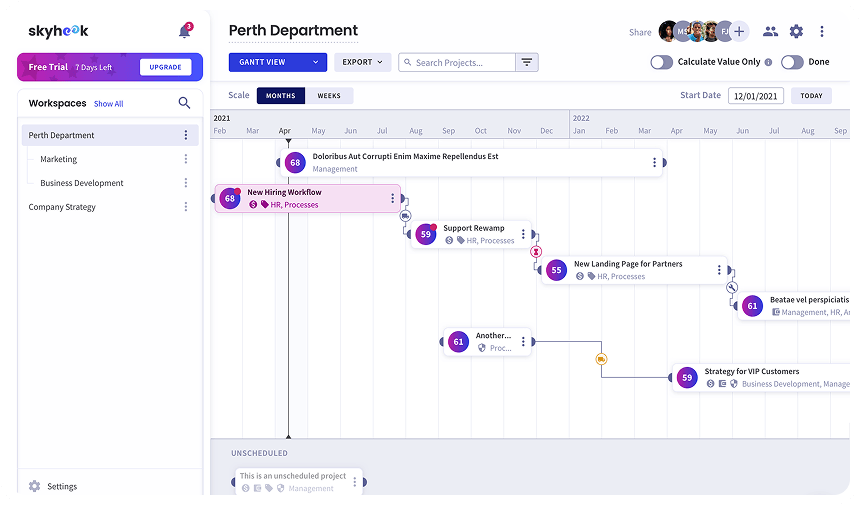
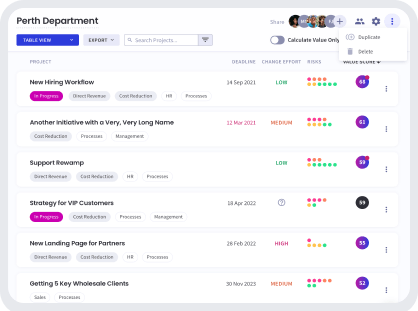
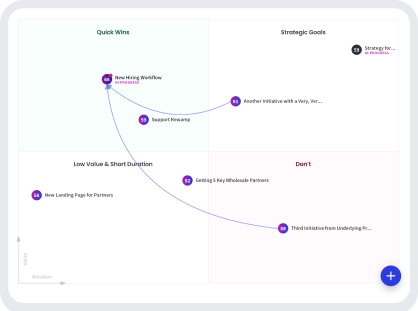
The technical challenge was real. The app had to ingest structured project data — tasks, dependencies, risks, costs, effort levels — and render it as interactive, decision-quality visuals: Gantt charts, Gartner-style quadrant views, and dependency flowcharts. Each of those required careful selection of graphing libraries and targeted customisation where the libraries didn’t do quite what was needed out of the box.
Alongside the SaaS application, the client also needed a marketing website — built to the same design guidelines, with a custom theme and page builder.
Validate per component. Build with the client watching. Integrate as each piece completed.
Before development started on any component, the Skyhook team’s feature designs were reviewed by our System and Business Analysts. The goal was to check proposed use cases against current standards and catch anything that would cause problems further down. This wasn’t a one-time review at the start — it happened per component, so each part of the app was pressure-tested before it was built.
Discussions on best practices and adjustments to live mockups happened with the client before development of each piece. That front-loading of alignment meant the build ran clean — fewer clarifications during development, almost no corrections after.
Backend and frontend were developed in parallel, with defined integration points as each component completed. Backend APIs were presented with simulated data for testing and alignment with frontend requirements — so both sides could validate independently before the real wiring happened.

Full SaaS web application
Custom UI capturing all required project data — tasks, dependencies, costs, risks, effort — with decision-quality visual output: Gantt charts (DevExtreme), quadrant views (Recharts), and dependency flowcharts

Custom graphing layer
Existing libraries selected on fit to client requirements; capabilities not available out of the box were added as targeted customisations, not rebuilt from scratch

Auth0 SSO integration
Single sign-on via Google and LinkedIn — users get in without friction, and the client doesn’t carry the auth infrastructure overhead

Marketing website
Built to Skyhook’s design guidelines using a custom theme and page builder, independent from but visually consistent with the application

Hybrid scrum delivery
Bi-weekly client reporting throughout; team scaled between 4 and 6 people depending on the phase, with continuity maintained across the engagement
An isomorphic stack chosen for performance at the data-processing end of SaaS.
The application runs on an isomorphic tech stack — NextJS and React on the frontend, NodeJS and PostgreSQL on the backend. The same codebase handles server-side and client-side rendering, which matters when the app is doing real-time data calculation and graphing for users who are processing a lot of information at once.
Object-relational tables organise the project data captured in the app. React Query and Axios handle API integration; React Hook Form manages data entry; React Toastify handles in-app notifications. Mailgun handles transactional email.
Frontend
Auth & Identity
Backend
Visualisation
A working SaaS product. 7 months. 5 stars on Clutch.
The full SaaS application and marketing website were delivered in 7 months, with a team that scaled between 4 and 6 people across the engagement. The hybrid scrum approach with bi-weekly reporting kept the client close throughout — no surprise reveals at the end.
The per-component design review paid off in practice. Because each piece was challenged and aligned before development started, the build ran without the usual cycle of mid-build corrections. The client had something to see and test at each stage, with backend APIs validated against simulated data before real integration happened.
The product does what it was built to do: takes raw project data — tasks, dependencies, costs, risks — and surfaces it as visual output that project managers and executives can actually use to make decisions. Gantt views, quadrant analysis, dependency maps. All in one application.

The Signal
The client had done the thinking before they arrived. What the engagement proved is that validating designs per component — before any code is written — is not overhead. It’s what keeps a 7-month SaaS build from turning into a 12-month one.

Other case studies
Tell us what you’re building.
Whether it’s a quick question or a detailed brief — we’d love to hear about it. We’ll respond within one business day with an honest, no-obligation reply.
- No sales pressure or lengthy process
- Response within one business day
- Honest assessment of whether we’re the right fit
- Fixed pricing, no hidden costs
- 10+ years of trusted delivery
No lengthy process.
Thank you for contacting us!